
| 영문 | aging, senescence | 한글 | 노화, 늙음 |
|---|---|---|---|
| 설명 | 나이 먹는다는 의미로 사용되기도 하지만 일반적으로는 성장이 완료, 정지되고 그 이후에 일어나는 모든 과정을 가리킨다. 나이를 먹어감에 따라 생체의 여러 가지 기능이 저하되는데, 일반적으로 세포에 색소가 축적되거나 세포자체나 핵이 작아지는 현상이다. 개개의 세포 기능도 저하되고, 세포 내에 색소가 침착되며, 기관은 암갈색을 띤다. 또한 피부는 얇아지고 털주머니도 위축되며, 모발은 색소를 잃고 탈모된다. 현재 많은 학자들은 세포내 DNA가 끊어지거나 끊어진 경우 수복력이 감소하거나, 면역력이 저하하기 때문으로 보고 있다. 노화가 일어나는 것은 세포의 종류에 따라서 크게 다른데 신경세포처럼 태어나서 죽을 때까지 세포분열하지 않는 세포는 노화가 두드러지고 고환이나 골수의 세포처럼 항상 분열하는 세포는 노화현상이 거의 일어나지 않는다. 발병과 죽음의 확률이 높아지지만, 노쇠성 변화와 병적 변화와의 경제는 명확하지 않다. 노쇠를 야기하는 노화의 본질적 원인에 대해서는 아직 정설이 없다. |
||
| 영문 | muscle cell(=muscle fiber) | 한글 | 근육세포 |
|---|---|---|---|
| 설명 | 근육은 수의근(의식에 의해서 조절이 가능한 근육: 예를 들어 다리, 팔, 얼굴근육 등)과 불수의근(의식과 무관하게 조절하지 않아도 움직이는 근육: 예를 들어 심장근, 소화기관에 분포하는 근육 등)으로 나누어지며, 근육세포의 모양은 다음과 같다(수의근, 불수의근 외에 심장에 있는 심장근은 불수의근에 해당하지만 그 모양은 수의근과 같아 따로 분류한다).  |
||
| 영문 | white blood cell(WBC), leukocyte | 한글 | 백혈구 |
|---|---|---|---|
| 설명 | 혈액내에 골수구계세포와 림프계세포, 단핵구계세포를 모두 통틀어 말한다. 백혈구의 증가가 있으면 대개 감염이 있거나, 혹은 탈수현상이 있음을 의미한다. 또한 지나친 백혈구수의 감소는 인체내 면역기능이 떨어져 있음을 의미하며, 다른 질병에 의해 나타나는 이차적인 현상이 아닌지 꼭 진단을 받아보아야 한다. |
||
| 영문 | mast cell | 한글 | 비만 세포 |
|---|---|---|---|
| 설명 | 동물의 결합 조직 가운데 널리 분포하는 세포. 결합조직과 점막조직 내에 있는 호염기성 색소로 이염색성(metachromasia)을 나타내는 과립을 가진 방추형의 세포에 작은 둥근 핵을 가진다. 비만세포의 표면에는 IgE에 대한 수용체가 존재하며, 수용체에 결합한 IgE 분자들끼리 다가의 항원에 의해 서로 연결되면 비만세포 과립탈출 반응이 일어나, 히스타민, 세로토닌, 헤파린 등의 화학전달 물질이 방출되어, 즉시형 알레르기 반응 등의 증상을 일으킨다. 피부, 장막, 혈관 주위, 점막 주변에 있다. |
||
| 영문 | cell | 한글 | 세포 |
|---|---|---|---|
| 설명 | 생명체를 이루는 구조적, 기능적 단위. 핵의 유무에 따라서 유핵세포와 무핵세포로 나눌 수가 있다. 무핵세포란 핵이 없는 세포를 말한다. 핵이란 유전정보를 가지고 있는 염색체를 보관하는 곳인데 무핵세포에서는 염색체가 세포속에 그냥 노출되어 있다. 대개 세포 하나하나가 독립된 생명체의 역할을 하는 단세포생물로서 외부환경으로부터 자신을 보호할 수 있는 견고한 세포벽을 가지고 있다. 유핵세포란 핵을 가지고 있어서 유전정보가 있는 염색체가 세포의 다른 부분과 구분되어 핵속에 들어있다. 세포속에서 핵외의 부분(이를 세포질이라 한다)에는 여러 가지 세포의 소기관이 있어서 세포의 다양한 기능을 분담한다. ◈유핵세포의 기본 구조 1.세포막-세포를 둘러싸서 주위환경과 분리하여 세포의 내환경을 유지한다. 2.형질내세망(endoplasmic reticulum)-단위막으로 둘러쌓여 있는 불규칙한 망상구조이다. 이 망상구조의 내부를 소강, 소조라고 부른다. 여기에는 표면이 매끈한 무과립형질내세망과 표면이 불규칙한 과립형질내세망의 두 가지가 있다. 과립형질내세망의 경우는 표면에 단백질을 합성하는 리보솜이라는 것이 부착되어 있다. 이곳은 주로 세포밖으로 분비할 단백질을 합성하는 장소이다. 무과립형질내세망은 표면에 리보솜이 부착되어 있지 않은 것을 말하며, 이곳에서는 주로 해독작용, 글리코겐의 합성, 스테로이드호르몬의 합성 등이 일어난다. 3.리보솜-단백질을 합성하는 역할을 하는 곳이다.이것은 세포질에 존재하는 자유리보솜과 과립형질내세망에 부착이 되어 존재하는 부착리보솜의 두 가지로 나눈다. 자유리보솜은 주로 세포내에서 필요한 단백질을 만드는 역할을 하고 부착리보솜은 세포밖으로 분비할 단백질을 만드는 역할을 한다. 4.골지장치(Golgi apparatus)-핵주위에 분포하는 납작해진 주머니모양의 것이 중첩되어 형성된 층판 모양의 구조물로 과립형질내세망에서 생성되어 외부로 분비될 단백질을 모아서 농축, 포장하여 과립을 만드는 역할을 한다. 5.사립체(mitochondria)-구형, 난형의 긴 막대기 모양으로 크기가 다양한 구조물. 생물체의 에너지 저장물질인 ATP를 생산하는 역할을 한다. 또 세포와 다른 자신만의 유전정보를 가진 DNA, RNA를 가지고 있다. 모양, 크기가 세균과 비슷하며 자체증식성 등 독립된 생명체로서 필요한 요건을 갖추고 있어서 세포와 공생관계를 가진 독립된 세포로 생각하고 있다. 6.용해소체(lysosome)-작은 구형의 소체로 여러 가지 분해효소를 가진다. 세포외계에서 들어온 물질과 결합하여 그 물질들을 용해하는 역할을 하고, 오래된 세포소기관들을 제거하는 역할도 한다. 7.세포핵(nucleus)-구형, 난형으로 세포의 중심에 위치한다. 핵내에는 유전정보가 있는 물질인 염색체가 존재한다. 8.중심소체(centrosome)-핵주위에 존재하면서 핵의 분열시에 양쪽의 염색체를 당기는 작은 섬유를 만드는 역할을 하는 곳. 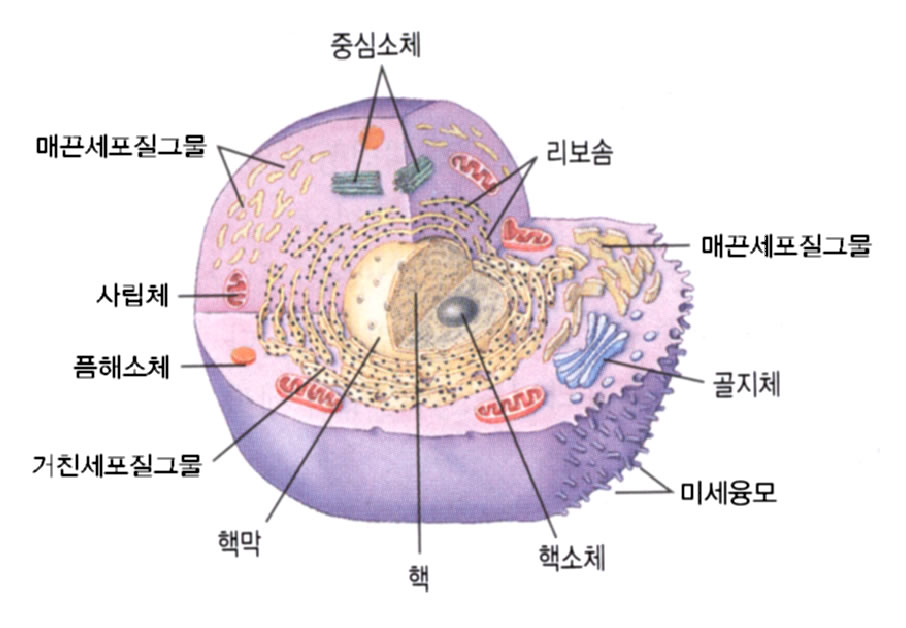 |
||
| MC | mass casualties; mast cell; Master of Surgery [Lat. Magister Chirurgiae]; maximum concentration; Med... |
|---|---|
| PCA | para-chloramphetamine; parietal cell antibody; passive cutaneous anaphylaxis; patient care assistant... |
| ACC | accommodation; acetyl coenzyme A carboxylase; acinic cell carcinoma; acute care center; adenoid cyst... |
| AAA | abdominal aortic aneurysm/aneurysmectomy; acne-associated arthritis; acquired aplastic anemia; acute... |
| AAHA | American Academy of Hospital Attorneys; American Association of Homes for the Aging |
| BLSA | Baltimore Longitudinal Study of Aging |
|---|---|
| CSHA | Canadian Study of Health and Aging |
| LSOA | Longitudinal Study of Aging |
| NIA | National Institute of Aging |
| ES cell | embryonic stem cell |
| cell aging | The decrease in the cell's ability to proliferate with the passing of time. Each cell is programmed for a certain number of cell divisions and at the end of that time proliferation halts. The cell enters a quiescent state after which it experiences cell death via the process of apoptosis. (12 Dec 1998) |
|---|---|
| aging | The gradual changes in the structure and function of humans and animals that occur with the passage of time, that do not result from disease or other gross accidents, and that eventually lead to the increased probability of death as the person or animal grows older. It does not apply to microorganisms. (12 Dec 1998) |
| aging, premature | Changes in the organism associated with senescence, occurring at an accelerated rate. (12 Dec 1998) |
| clonal aging | The deterioration in successive generations of a clone; thus paramecia and other simple forms, if allowed to reproduce asexually for a number of generations, invariably undergo deterioration, the characters of each group of descendants progressively departing from those of the original sexually produced ancestor. (05 Mar 2000) |
| skin aging | The process of aging due to changes in the structure and elasticity of the skin over time. It may be a part of physiological aging or it may be due to the effects of ultraviolet radiation, usually through exposure to sunlight. (12 Dec 1998) |
| erythrocyte aging | Senescence of the red blood cell. Lacking the organelles that make protein synthesis possible, the mature erythrocyte is incapable of self-repair, reproduction, and carrying out certain functions performed by other cells. This limits the average life span of an erythrocyte to 120 days. (12 Dec 1998) |
| T-cell-rich, B-cell lymphoma | <tumour> A B-cell lymphoma in which more than 90% of the cells are of T-cell origin, masking the large cells that form the neoplastic B-cell component. See: adult T-cell lymphoma. (05 Mar 2000) |
| absorption cell | A small glass chamber with parallel sides, in which absorption spectra of solutions can be obtained. (05 Mar 2000) |
| acid cell | One of the cell's of the gastric glands; it lies upon the basement membrane, covered by the chief cell's, and secretes hydrochloric acid that reaches the lumen of the gland through fine intracellular and intercellular canals (canaliculi). Synonym: acid cell, oxyntic cell. (05 Mar 2000) |
| acidophil cell | A cell whose cytoplasm or its granules stain with acid dyes. (05 Mar 2000) |
| acinar cell | Any secreting cell lining an acinus, especially applied to the cell's of the pancreas that furnish pancreatic juice and enzymes to distinguish them from the cell's of ducts and the islets of Langerhans. Synonym: acinous cell. (05 Mar 2000) |
| acinar cell tumour | A solid and cystic tumour of the pancreas, occurring in young women; tumour cells contain zymogen granules. (05 Mar 2000) |
| acinic cell adenocarcinoma | <tumour> An adenocarcinoma arising from secreting cells of a racemose gland, particularly the salivary glands. Synonym: acinar carcinoma, acinic cell carcinoma, acinose carcinoma, acinous carcinoma. (05 Mar 2000) |
| acinic cell carcinoma | <tumour> An adenocarcinoma arising from secreting cells of a racemose gland, particularly the salivary glands. Synonym: acinar carcinoma, acinic cell carcinoma, acinose carcinoma, acinous carcinoma. (05 Mar 2000) |
| acinous cell | Any secreting cell lining an acinus, especially applied to the cell's of the pancreas that furnish pancreatic juice and enzymes to distinguish them from the cell's of ducts and the islets of Langerhans. Synonym: acinous cell. (05 Mar 2000) |
제품명 |
판매사 |
보험코드 | 성분/함량 | 구분/보험급여 |
|---|
제품명 |
판매사 |
보험코드 | 성분/함량 | 구분/보험급여 |
|---|